Ok. I know. It has been a long, looooong while since I posted a recipe. But I’ve been making a ton of fun viral recipes so I thought I would post the ones I have actually tried and I liked – sort of like those folks on TikTok who try viral recipes so you donlt have to.
Thats what this is – I found it somewhere on a social post in the interweb… no idea where now so I can not give credit but I have tweaked it enough that I think that should be ok…
So because of my age and stage (51 years young in perimenoupause – so so fun right?) I have been making sure to try to get enough protien – did you know that the average woman needs about 100 grams of protien a day and most of us dont get there. Why do we need more protien now? Well we need the amino acids which are the building blocks of protien because we are losing some from our own muscles so the way to replace – eat enough protien and lift heavy things (not kidding -get on the weight lifting ladies!). After the age of 50 people lose 1-3 % of their muscle mass every year so if you live till 80 you will have lost 30-90% of your muscle mass unless you do things to preserve it! I am now activly training to be able to get off the toilet when I am 80, no joke.
Ok back to the recipe… lots of protien, super quick and easy and super tasty!
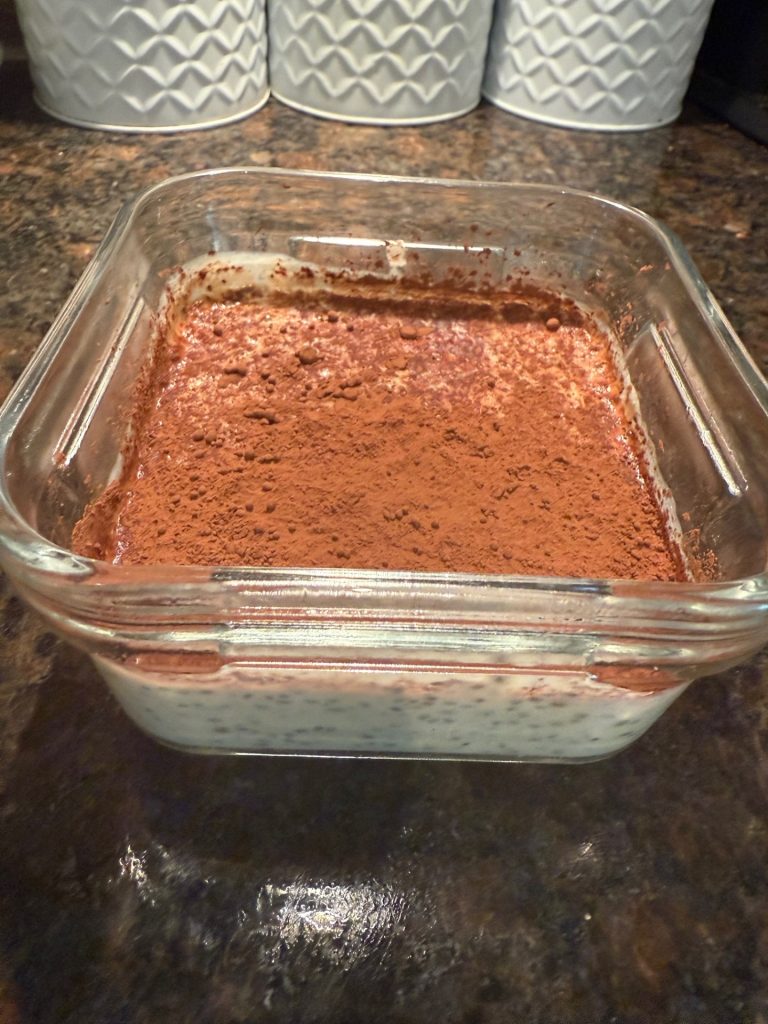
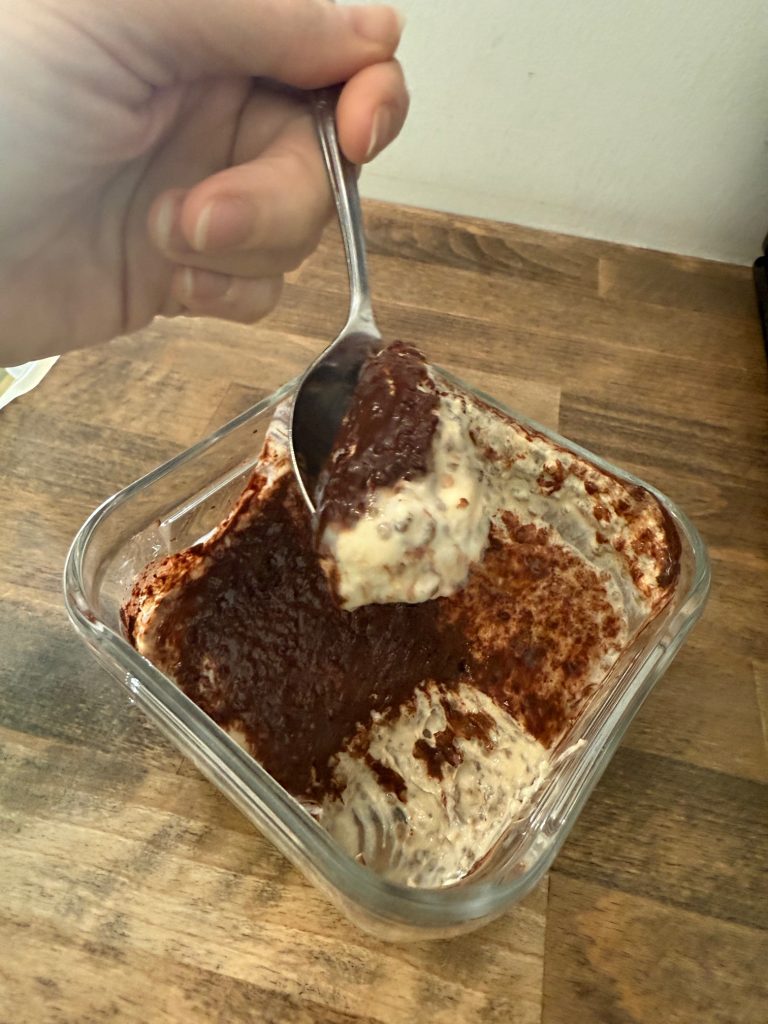
This one is so simple it takes me 5 mintues to make and I chill overnight and eat the next day – there is so much protien in it that I am full for hours and it is so tasty that I make it several times a week for myself – no joke!
Here is what you need
Ingredients
100 grams plain high protien Greek Yogurt or Skyr
1 scoop protien powder (vanilla preferred)
2 Tbsp chia seeds
2-3 Tbsp leftover coffee (I make this when there is a bit left over in the pot from the day)
about 1/2 tsp cocoa powder to taste
Directions
Mix all together except cocoa powder and put in a container overnight in the fridge. I use a glass container with a sealable lid so I can take this to work the next day. In the morning dust the top of the tiramisu with cocoa powder. That is it. eat and enjoy – this bad boy has about 265 calories and 38 grams of protien depending on the type of yogurt and protien powder you use so if increasing your protien is something you are looking to do this is a great and super delicious way to do it!
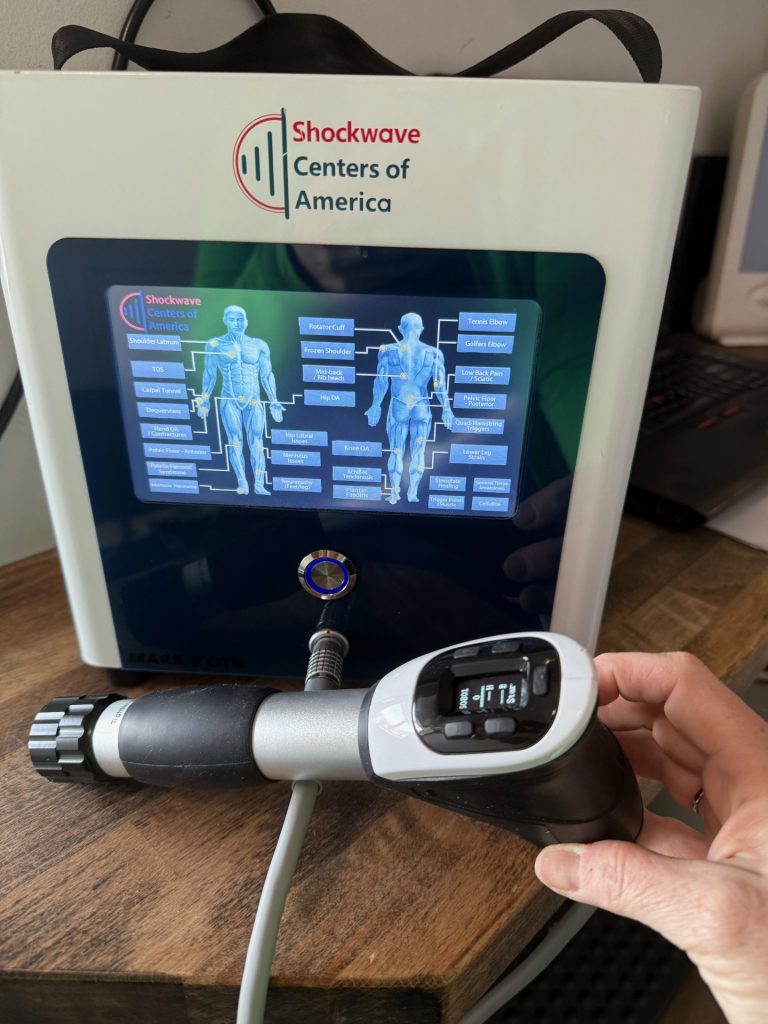
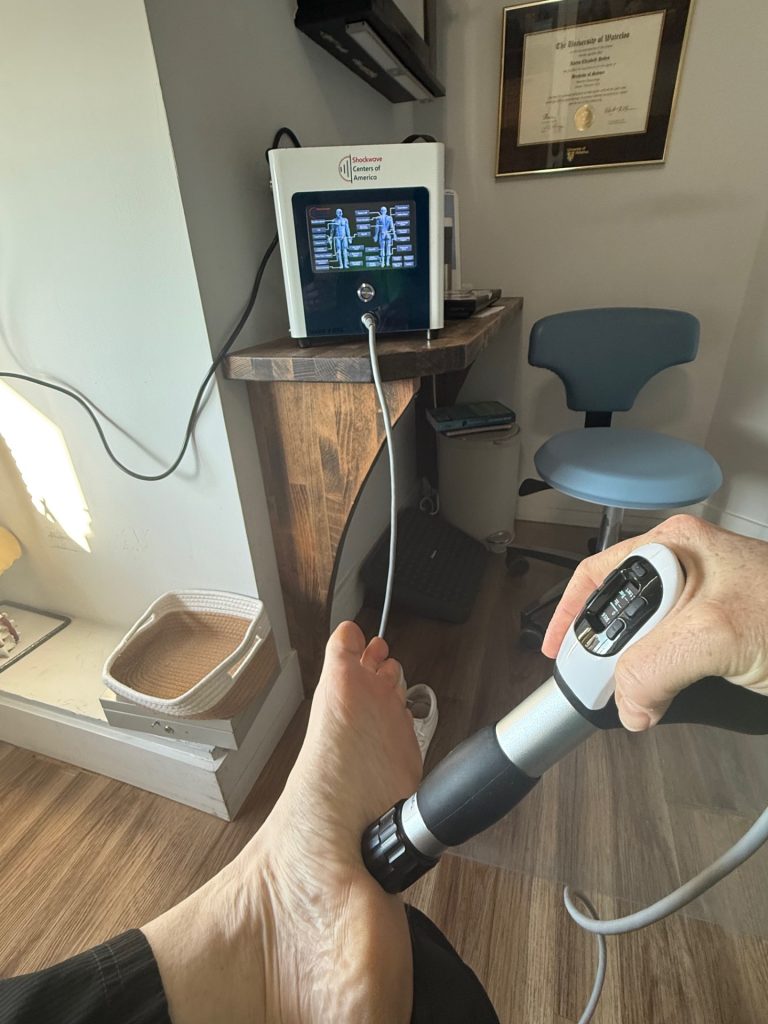
my portable shockwave machineme treating my own foot with shockwave
If you’ve been dealing with stubborn pain that just won’t go away—no matter how much stretching, rest, or treatment you’ve tried—shockwave therapy might be the missing piece.
In my chiropractic practice serving Lawrence Park and York Mills, I use shockwave therapy regularly to help patients move past chronic pain and finally start healing.
What Is Shockwave Therapy and How Does It Work?
Shockwave therapy uses acoustic waves to stimulate healing in injured or chronically irritated tissues like tendons and fascia.
These waves deliver mechanical energy into the tissue, which helps:
Increase blood flow
Stimulate cellular repair
Break down stubborn scar tissue or calcifications
In simple terms, it “wakes up” tissue that has stopped healing properly.
When I was first looking into bringing shockwave into the clinic, I came across a story I still love. The technology was discovered over 30 years ago—possibly during blast testing. People living nearby were later surveyed, and unexpectedly, many reported decreased pain from conditions like tendonitis and arthritis.
Was it the acoustic waves affecting tissue at a cellular level? That’s what researchers began to explore—and what eventually led to modern shockwave therapy.
Whether or not that’s the full story, the results we see today are very real.
Shockwave vs. Ultrasound or Laser Therapy
A question I hear all the time is how shockwave differs from other therapies.
Ultrasound and laser primarily deliver energy through heat or light. Shockwave is different because it delivers a stronger mechanical stimulus that encourages a more active healing response.
This makes it particularly helpful for:
Chronic injuries
Stubborn tendon issues
Pain that hasn’t responded to other treatments
Is Shockwave Therapy Evidence-Based?
Yes—there is strong and growing research supporting shockwave therapy for chronic musculoskeletal conditions.
Studies show positive outcomes for:
Plantar fasciitis
Tennis elbow
Frozen shoulder
Achilles tendinopathy
That said, it works best when used as part of a comprehensive plan. In my clinic, I combine shockwave therapy with proper diagnosis, targeted exercises, and hands-on chiropractic care to get the best results.
What Conditions Can Shockwave Therapy Treat?
Shockwave therapy is most effective for chronic tendon and soft tissue issues—especially ones that have been lingering for months.
Common conditions we treat include:
Plantar fasciitis (heel pain)
Tennis elbow and golfer’s elbow
Achilles tendinopathy
Patellar tendinopathy (jumper’s knee)
Rotator cuff injuries
Frozen shoulder (including calcific tendonitis)
Conditions I Was Honestly “Shocked” It Helped
There are also some conditions where the results have surprised even me.
I personally dealt with plantar fasciitis in both feet (likely related to perimenopause and hormonal changes). After about 8 treatments, my pain was completely gone—even though the root cause hadn’t changed.
I’ve also seen great results with:
Chronic lower back pain (especially in people who sit most of the day)
Persistent trigger points
Foot osteoarthritis (pain relief and improved function)
Other conditions that often respond well include:
Chronic hip or gluteal tendon pain
Neck tension and stiffness
Long-standing muscle tightness
Pain associated with osteoarthritis
What Does Shockwave Therapy Feel Like?
The best way to describe it is like a light elastic band snapping against the skin.
Some areas can feel tender, especially if already irritated, but treatments are very manageable.
In my clinic:
I keep the intensity at a comfortable level (no more than 3/10)
I adjust based on your feedback
Each area takes about 3–5 minutes
When I first started offering shockwave, it was more uncomfortable. Over time, I’ve refined my technique so treatments are much more tolerable.
What Should You Expect From Treatment?
Shockwave sessions are quick and efficient.
Most patients need:
5–8 treatments
Typically spaced one week apart (sometimes twice weekly)
After treatment, you may feel mild soreness for a day or two—similar to how you feel after a good workout. This is normal and part of the healing process.
Some people notice improvements early, but more often the biggest changes happen gradually over several weeks as the tissue repairs.
The goal is not just short-term relief—but long-term healing.
Is Shockwave Therapy Right for You?
If you’re dealing with pain that:
Keeps coming back
Hasn’t improved with other treatments
Has been present for months
Shockwave therapy may be exactly what your body needs.
At my clinic in the Lawrence Park and York Mills area, I use shockwave as part of a personalized, hands-on approach to care—so you’re not just feeling better temporarily, but actually healing.
Ready to Get Started?
If you’re curious whether shockwave therapy is right for you, I’d be happy to help.
Book an appointment today and let’s create a plan to get you moving—and feeling—like yourself again.
This week we will start a 10 part series on lower back pain. There are so many causes of lower back pain we wont even try to cover them all here but I will mention the most common and give a few good exercises for most back problems in general for strengthening. Today we will start with the number one most common back problem: disc herniation
Disc herniation and back pain
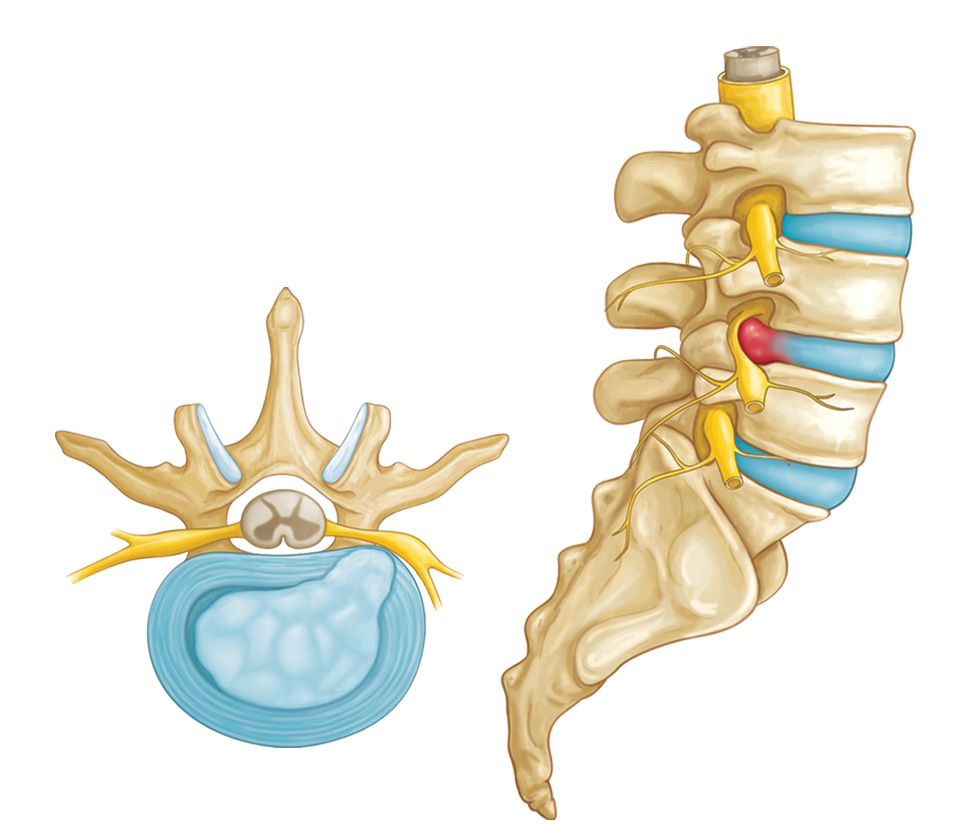
This is a super common cause of back pain and can range in severity from mild low back pain to excruciating pain with or without pain down one or both legs all the way to the foot. It can also cause tingling and numbness. But, did you know a whole bunch of the population walks around with a disc bulge without knowing it at all? On MRI 50% of people found to have this feel nothing. So, what is this? Picture a jelly donut. Got it? This donut sits between 2 vertebrae and we call it the disc. Ok, sometimes the jelly in the middle of the donut works its way through the outside ‘dough’ and comes out or pushes the dough out in a spot – this lump or extruded jelly can put physical pressure on nerves or cause a ton of inflammation in the area which also puts pressure on nerves – your body interprets this as pain.
Disc Herniations influence the nerves and cause pain
What to do about back pain from a herniated disc
First get checked by your chiropractor or other healthcare provider. It is important to have an accurate diagnosis to know what to do. Remember that exercises I give are general ones and may not be right for you. If you do have a herniated disc you will most definitely need hands on care to heal.
A great exercise for lower back pain
As a sweeping generalization though this extension exercise is great for most people and the first one I give to patients with a disc bulge or disc herniation. All you do is stand up and put your hands on your lower back and then gently extend or arch your back then stand right back up. Do this 5-6 times. It takes about 20 seconds. For those with an acute problem I get then to do this once an hour. Others I recommend a few times per day as it is protective and the opposite than all the flexion we usually do (sitting, bending, slouching). See my YouTube video below for a visual demonstration. If you try this and it increases you pain – STOP and ask your healthcare provider. Always listen to your body!
So while there is not usually one reason only for pain that comes on slowly, our repeated postures and actions play a large role in getting us there. As I have said so many times you are probably sick of it, problems including upper back pain, are usually cumulative and build over time (unless you have an acute injury). Poor ergonomics and upper back pain are related to each other ; In fact ergonomics can be linked to all sorts of different body pain but here we will focus on upper back.
The way we sit at our computer desk for hours per day definitely plays a role in joint health. There are ways to make the impact less in almost all situations and help prevent things like upper back pain (and of course other pain).
Ergonomics and upper back pain tips and tricks
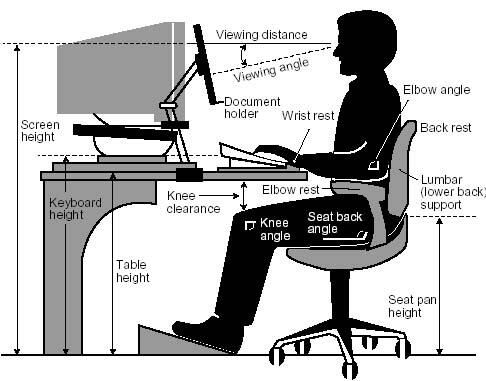
So, there are some easy quick tips for desk ergonomics that help the upper back. In this newsletter and blog post we will focus on the ones for upper back pain. Later will address lower back pain in another post when we talk more about the lower back. So some quick points to check on your desk:
Monitor at or above (even better) eye level. This means if you have a laptop you need a monitor riser and a wired or wireless keyboard and mouse. Trust me the money invested in these is worth it.
Shoulders should be at rest and arms in the 90/90 position (meaning you should have a 90 degree bend at the elbow and shoulder at rest with little to no forward flexion)
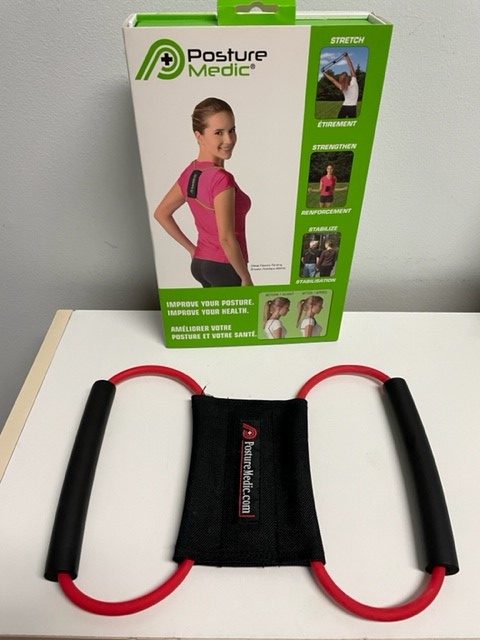
Use the Posture medic 15 min every hour to help train upright posture – this may mean you need to raise your monitor even more as you get better! Don’t be afraid to do that!
If you have the ability and means get a sit/stand desk and change position every hour or two – remember cumulative trauma is the thing that causes problems so don’t let them accumulate so long!
This week I will continue down the road of posture and give you my favorite upper back strengthening exercise to help with posture and losing the slouch of your upper back and shoulders.
Strengthening the muscles that this exercise targets is important for upper back pain because they are generally muscles that tend to be weakened in people and cause poor posture. So since poor posture can be a cause of upper back pain in the first place, it is important to fix the underlying cause, or at least one of them. Remember though doing this exercise will help you best when combined with adjustments. If the joints are just not moving you are essentially running into a brick wall. The adjustment helps free up the mobility and then we need to retrain the muscles. Both parts are important, or we will just end up doing the same thing over and over again and not correcting the posture.
My favourite exercise for upper back strengthening is wall angels. You need a bit of empty wall space for this one. Stand with the back of your heel and your butt touching the wall. Put your arms up over your head in a ‘cactus’ position and make sure your upper arms, forearms, wrists and hands are touching the wall and stay flat against it the whole time. This sounds simple but is the hardest part. Now slowly draw your elbows down skimming the wall until they get as close to your waist as you can. Repeat this 5-10 times (start with 5).
This sounds easy but is really hard and most people let their hands and/or wrists come up off the wall at some point. The goal is to keep them flat. Try squeezing the muscles between your shoulder blades when you do this.
To see the YouTube video that I made for this exercise please click here
Last week we talked about back packs – good (and bad) use of backpacks definitely play right into upper back pain and posture over time so if you missed it click here for the link to it. This week more on posture.
I get asked all the time about the relationship between poor posture and upper back pain. There is a direct relationship for sure. Poor posture and slouching puts pressure on lots of different spinal structures. I know I keep saying this, but damage is cumulative and builds over time. Eventually one day you wake up in pain and aren’t sure why. Or maybe you do something small like lift a glass and “ouch!”. Well, the glass wasn’t too heavy it was just the last thing. The thing that broke the camel’s back. Yes, you are the camel in this example.
What to do about bad posture and upper back pain
Best thing to do is prevention. So, we need to help correct posture before it turns into upper back pain or any other pain. I get moms of teens in the office all the time worried about their teenager’s posture. And for good reason! If we can help correct bad habits before they become too ingrained, it is better for everyone. So, what do we do. For most people we start with a series of adjustments because if the joints are just not moving you could do all the stretching and yoga you would like but you are basically running up against a brick wall. That brick wall is your joints and if they aren’t moving through their normal range of motion, you need an adjustment or a series of them to get them moving again.
Ok I got adjusted – now what
For posture correction one of the tools I use is something called the posture medic. I sell this product at the office and it is a stretchy tube with padding that you put on like a backpack and it helps serve as a reminder not to slouch and put your shoulders back as we are helping correct your posture. While it wont fix anything it will help break habits and build new ones if you use it! I usually suggest people wear it for 15 minutes every hour they are sitting at their computer to start. That adds up to a lot in an 8-hour workday!
This is week three of our series about upper back pain and with back to school we will talk about backpack safety. But first here are the links to the previous two weeks blog incase you missed them:
This week since the kids in the GTA go back to school on Wednesday I thought I would talk about backpack safety. Backpack safety is important for not only upper back pain but all back pain and joint health. This is particularly important for our kiddos but as well for everyone who uses a backpack – I still do! Damage to joints and the cause of pain and long-term problems are cumulative so everything you can do for your kids, and you help. This includes regular adjustments and of course ergonomics and backpack safety – which is just really proper or best ergonomics to use while wearing a backpack.
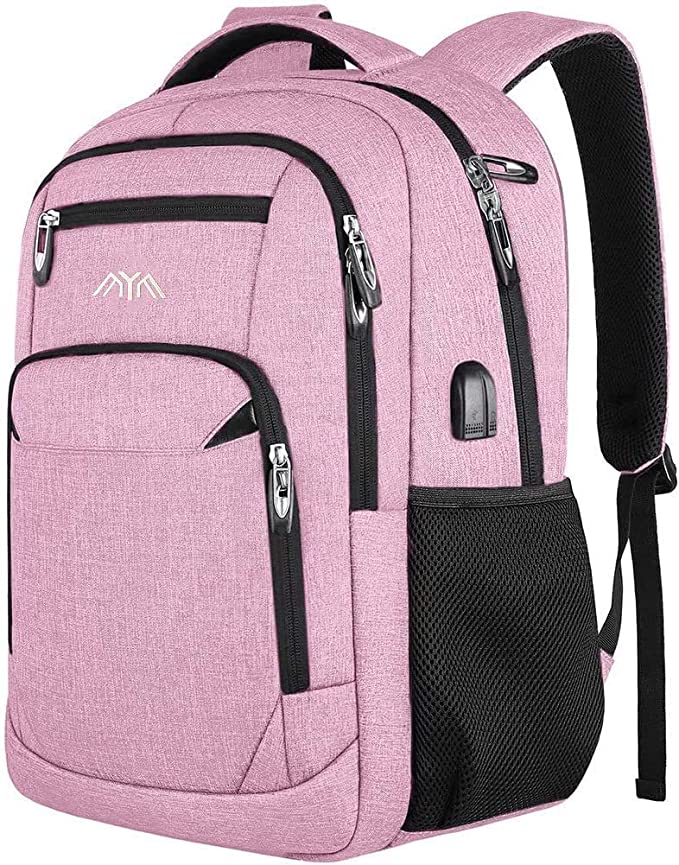
backpack safety – choosing the right one for you or your child
Backpack safety tips
Ok so I am going to do this in point form because it is probably easier that way. Here are the tips I have for protecting yourself from upper back pain and all joint damage while wearing a backpack.
Choose a well-made backpack including wide straps and a padded back
Choose a lightweight backpack
Do not overpack – the weight of your pack should not be more than 10% of body weight
In order not to overpack take just what you need for the day
Keep the load as close to the back of the pack as possible (not in only the front pouches)
Wear both straps at the same time not just one
Use the waist strap if there is one to support some of the weight
Get in the habit of placing your pack on the table and turning around to put on both straps instead of slinging over your shoulder
Here is where you can get more information on backpack saftey
So those are our tips for this week – for more please see the links included below from the Ontario and Canadian Chiropractic associations regarding backpack safety!
This week I will give you a great upper back pain stretch for pain and one for neck strengthening. While I use these for people at the clinic with upper back pain due to rib problems I also use if for neck pain, and other causes of upper back pain.
Last week we started a series on Upper Back pain and talked about how to decrease pain between the shoulder blades (due to ribs not moving well). If you missed it here is the link to the blog post: https://drkarenhudes.ca/index.php/2022/08/18/upper-back-pain/
Upper back pain stretch 1
So, the first one is a true stretch, and it is called the levator scapulae stretch. Really you want to do all stretches on both sides, but we are going to talk about this for the side of pain ok? I will talk you through this stretch for upper back pain and below is a link to a YouTube video I made so you can follow along more easily.
Let’s pick the left side as the side of upper back pain for this example. First drop your chin to your chest. Now rotate your head to your right armpit so your nose is pointing in that direction. Now place your right hand over the top of your head and gently pull down. You should feel a stretch along the back left side of the neck and maybe all the way to your shoulder blade if you are doing this right. Next take your left hand and grab the back of the seat of your chair if you want a bigger stretch. Hold for at least 20-30 seconds or longer
For the link to the YouTube video for this stretch click here
Stretch 2
For this upper back pain stretch one I am lying just a bit. It is more of a strengthening exercise, but I feel a stretch at the back of my neck, probably because I am super tight and need it. This is a doubly good one for upper back pain because it is relieving and strengthening. This one is called resisted retractions. I do this in the car. DON’T DO IT WHEN DRIVING! I do this at a red light. Make a double chin. Push your head back into the headrest (think of the action a pigeon does). Hold for 10-20 seconds or longer as you get better at it
Ok that’s it for this week. Next week in honour of school starting (yes I know, shhhh!!!! Sorry!!!) we will talk about backpack safety and ergonomics for the kiddos (and any of us overage kiddos like me who still use backpacks sometimes).
Ever have pain in the upper back, near your shoulder blades, in your lower neck or traps (sometimes patients call this their shoulders), your neck or have headaches? If you have then read this newsletter and blog – if not read it anyways you or someone you know may need it. I’ll keep it short and sweet.
Every week for the next 5-6 weeks our newsletter Quick Tip Tuesday will have a short tip on upper back pain. I will be posting these on our blog each week too so you will continue to have access to it. Each week we will have a bit of a different focus and one or two quick things you can do to help yourself with upper back pain. Then each month or so a new topic will start and we will do the whole thing over again! So please feel free to share this newsletter and the blog posts with friends and family who you think it could help!
Pain relief for upper back pain
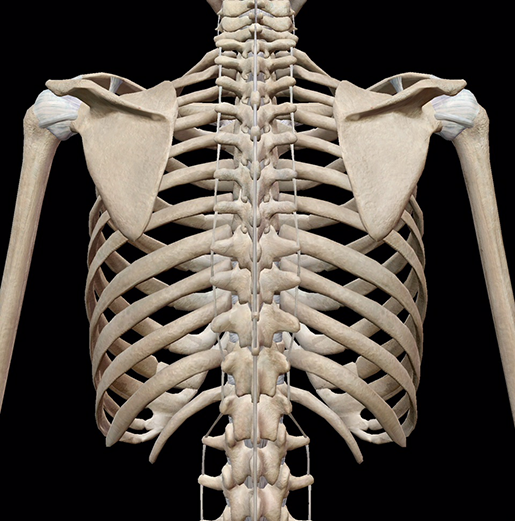
This week we will focus on pain relief for upper back pain. I will tell you that a lot of upper back pain that I treat is caused by the ribs. So, a lot of my patients have never thought of their ribs except the ones that sort of stick out near the upper part of their belly. But the ribs form a cage around the lungs and heart. The ribs are supposed to move up and down very slightly like a bucket handle with every breath but sometimes they stop moving correctly. But why? Life, lifting, sitting, ergonomics, injury, the list is endless and there is rarely one reason this happens. The truth is that problems are cumulative and getting adjusted regularly really helps avoid things like this kind of upper back pain.
Too late and you already have pain?
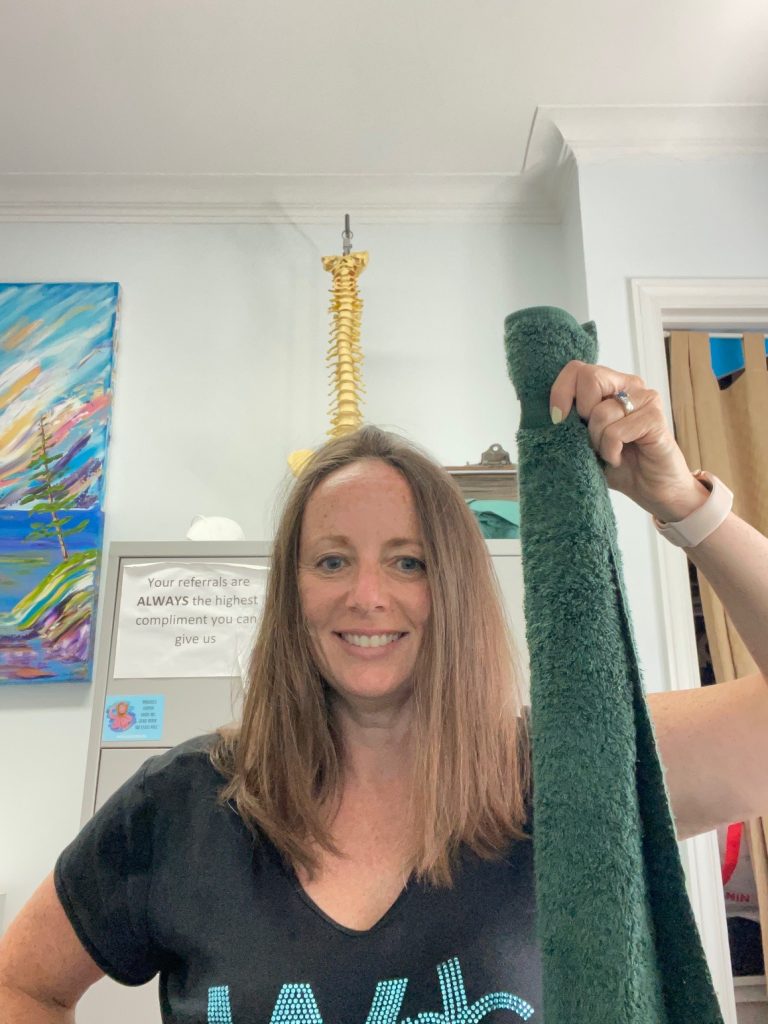
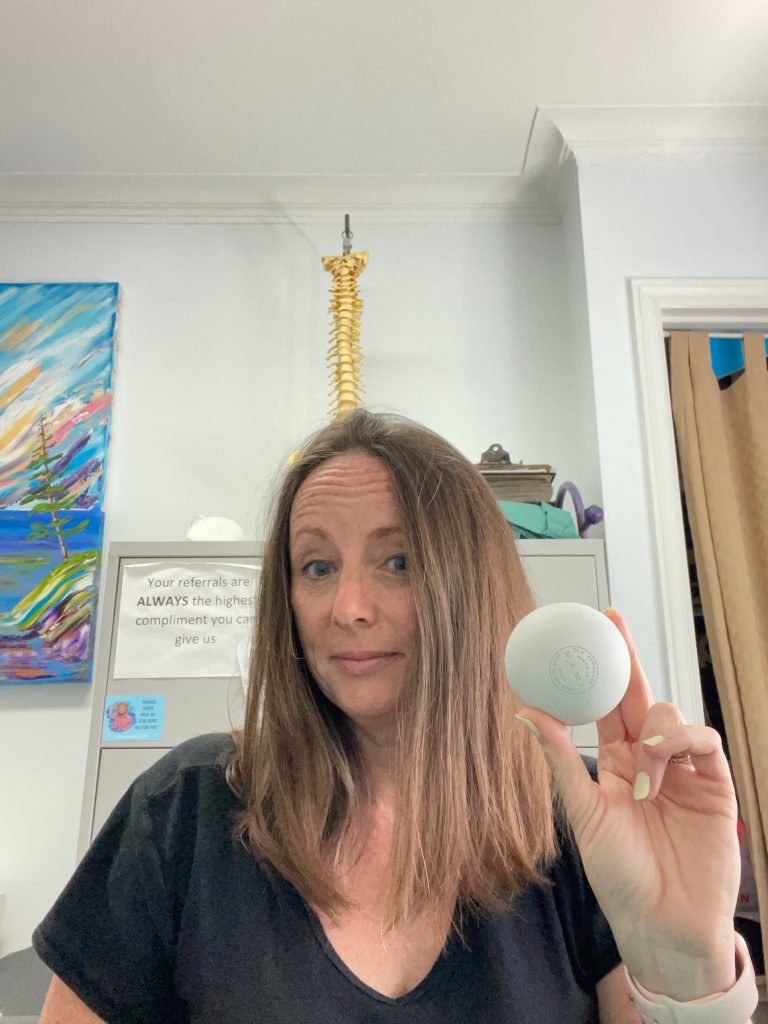
Don’t fret, if you have pain already, I am going to give you a quick tip to help yourself right now if this rib problem is the issue. Of course, you should come in and get checked out to be sure this is the issue so please book an appointment so we can make sure you are doing all the right things to heal. In the meantime, try the towel trick or using a ball like a lacrosse ball on that spot between the spine and the shoulder blade and lay on it with your arms outstretched in a T formation for about 5 minutes. This should help ease the pain for a time. Also please ice it for about 10 minutes. Please see the youtube videos below that I created for these two tips!
Towel trick exercise
For a link to the towel trick exercise for upper back pain click here
lacrosse ball trick
for a link to the lacrosse ball trick for upper back pain click here
While this is not going to fix all of your upper back pain it will be a pain decreasing measure you can take right now at home until you can come in to see me. A few adjustments may be needed to get that rib moving again, calm down the inflammation and let the muscles relax. We’ve got this!
Next week once you are out of acute upper back pain we will talk a bit more abour things you can do to help stretch those muscles!
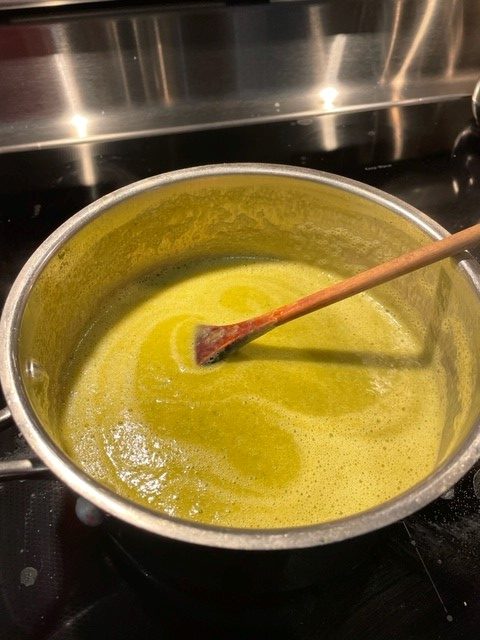
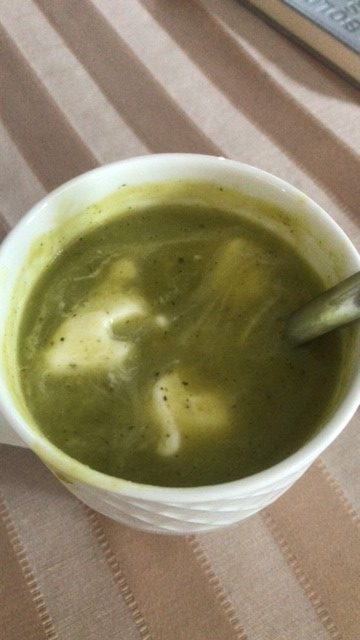
It is officially fall. Dark and all. One of my fave things in fall is soup. I love soup! Apparently I love it so much that I talk about it with my patients and that is how I was given this recipe for zucchini soup. Thank you Bob! (ok really thank you to Bob’s wife). THis one is so simple and so amazing I know I am going to make it all winter – oh yeah and grow more zuccini next summer too.
pot of zuccini soup
Ingredients
4 medium zuccini
1 sweet onion (I use the green part of green onions only to make this FODMAP friendly)
4 cups veggie or chicken broth
1 clove garlic (optional)
salt and pepper to taste
Super simple directions for Zucchini Soup
Cut up onions or green portions of onions and saute in bottom of pot in a little oil or butter until fragrant. Add garlic if using and saute 30 seconds. Add broth and then chop up zucchini coarsly into rounds. Heat on high until boiling then turn down to a simmer until zucchini is soft about 20-30 mintues. Blend in batches until smooth or use immersion blender. Add salt and pepper to taste and add water if it is too thick. Serve with dollop of sour cream and chives as garnish.
This soup is so darn easy and way tastier that I would have given zucchini credit for. In case you were wondering what a FODMAP food was check out this link. I cut out onions because they tend to make me gassy… instead I substitue the green part of green onions or leeks for the flavour and it works beautifully. Let me know if you tried this recipe!